On this page
Measuring the Chandler Wobble with VLBI

Overview
The Chandler wobble is a free oscillation of Earth’s rotation axis relative to the solid Earth. Its characteristic period is roughly 430–435 days. Unlike the annual component of polar motion, which is driven by seasonal redistribution of atmospheric, oceanic, and hydrological mass, the Chandler wobble is a natural rotational mode of the Earth.
Precise measurements of polar motion are part of the Earth Orientation Parameters (EOP). Modern space-geodetic techniques—including Very Long Baseline Interferometry (VLBI), GNSS, Satellite Laser Ranging (SLR), and Lunar Laser Ranging (LLR)—are combined to determine Earth orientation with very high precision.
Electromagnetic connection: Very Long Baseline Interferometry
VLBI is fundamentally an application of radio-frequency electromagnetics and interferometry. Radio telescopes separated by hundreds to thousands of kilometres observe the same distant compact radio source, usually an extragalactic quasar.
Because quasars are extremely distant, their incoming radio waves can be treated approximately as plane wavefronts. The wavefront reaches different antennas at slightly different times. For a baseline vector $\mathbf{B}$ and source direction $\hat{\mathbf{s}}$, the leading geometric delay is approximately
\[\tau_g \approx \frac{\mathbf{B}\cdot\hat{\mathbf{s}}}{c},\]where $c$ is the speed of light.
The received broadband radio signals are time-tagged using highly stable frequency standards and cross-correlated. Measuring the delay between stations constrains the orientation of the terrestrial baseline relative to the celestial reference frame.
VLBI receiver-to-geodesy architecture
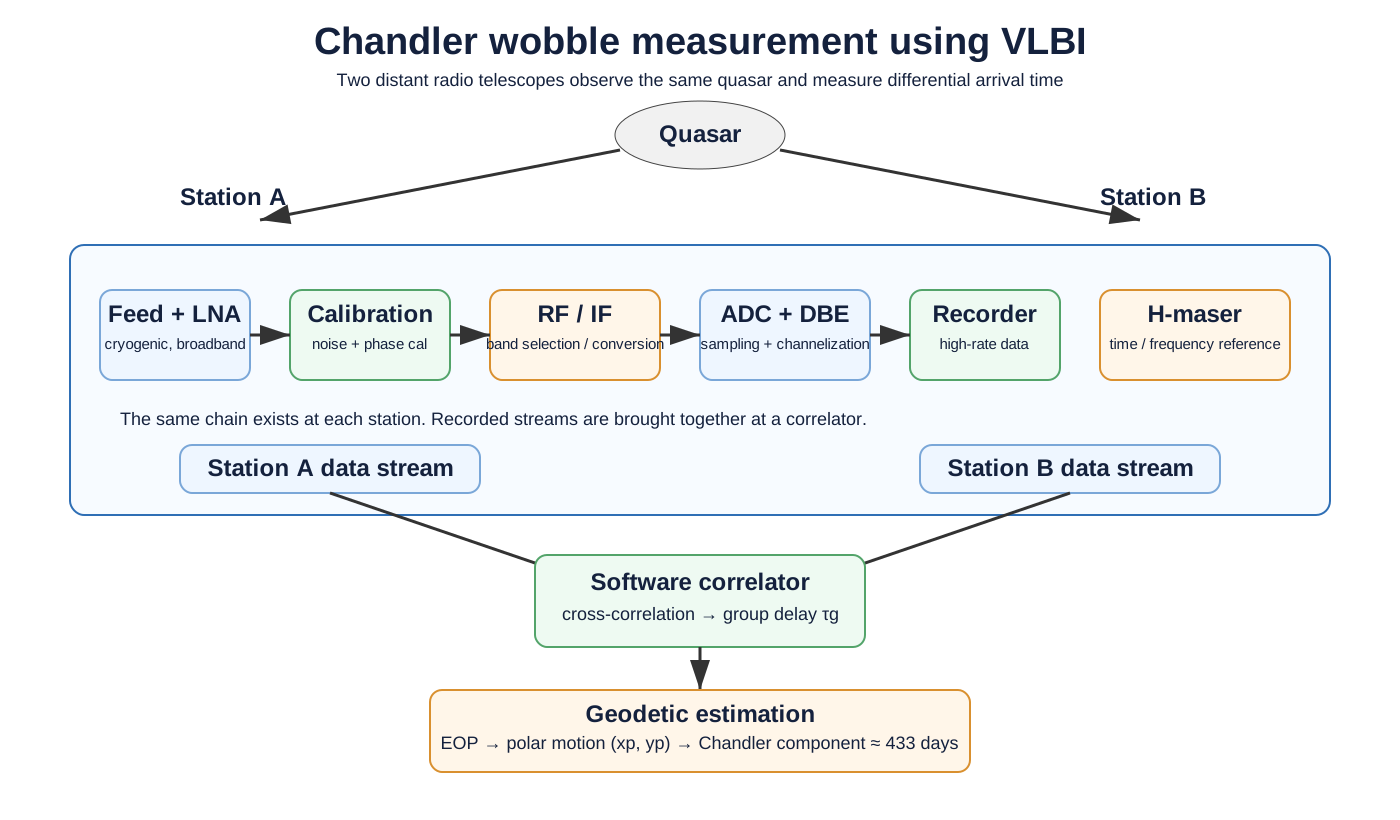
Receiver-level view of the measurement chain: broadband quasar signals are amplified, calibrated, frequency-converted/digitized, recorded at geographically separated stations, and cross-correlated to estimate group delay. The resulting delays enter a global geodetic solution for Earth Orientation Parameters and polar motion.
Modern VGOS broadband receiver
The VLBI Global Observing System (VGOS) replaces the legacy fixed S/X-band approach with a broadband architecture designed for improved delay precision, rapid source switching, stable calibration, and high observing throughput.
A typical VGOS signal chain uses a cryogenic dual-linear-polarization feed covering approximately 2–14 GHz, followed by broadband low-noise amplifiers. Noise and phase-calibration signals are injected near the front end so that instrumental gain and delay can be monitored through the downstream electronics. The broadband RF is commonly transported from the antenna to the control room over optical fiber, where four observing bands are selected and translated to intermediate frequency for digitization and digital channelization.
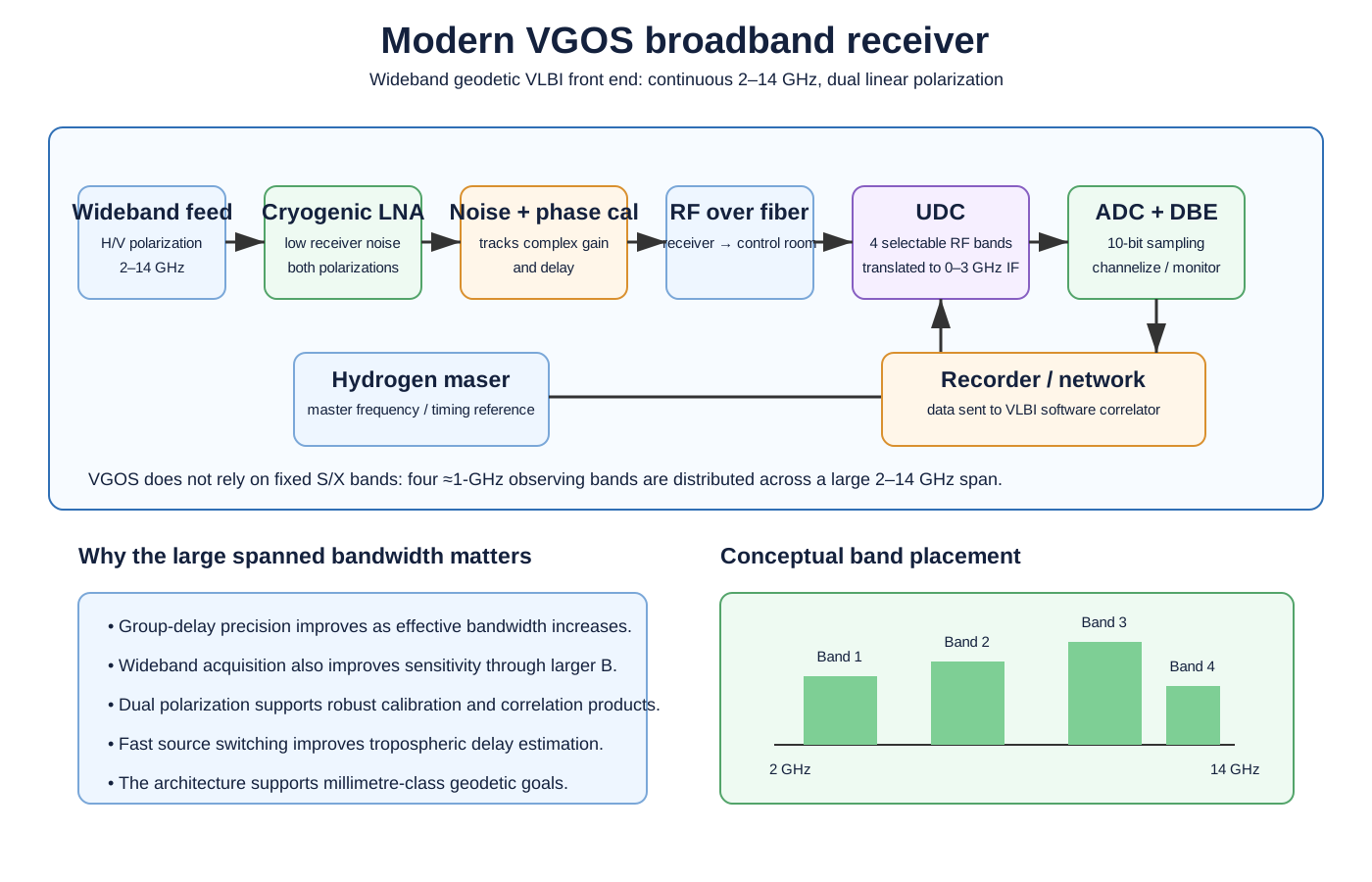
Conceptual VGOS receiver architecture. Four approximately 1-GHz observing bands can be distributed across the much larger 2–14 GHz span. The large effective spanned bandwidth improves group-delay precision, while dual polarization, high-rate digitization, calibration injection, and hydrogen-maser timing support precision geodetic VLBI.
The IVS VGOS concept specifies four RF bands that can be placed flexibly within the 2–14 GHz range. In the reference implementation, each selected band is translated to an IF in the 0–3 GHz range, sampled at 10 bits, and processed in an FPGA-based digital backend for channelization, bit truncation, power monitoring, and calibration detection. A hydrogen maser supplies the frequency and timing reference for the calibration system, converters, and digital backend.
From radio waves to Earth’s wobble
VLBI therefore creates a direct measurement chain:
quasar radio emission → electromagnetic wave propagation → geographically separated radio telescopes → interferometric time delay → terrestrial/celestial reference-frame orientation → Earth Orientation Parameters → polar motion.
Repeated observations of many quasars with a global telescope network allow the orientation of Earth to be determined relative to the nearly inertial International Celestial Reference Frame (ICRF). VLBI is particularly important because the ICRF itself is realized from VLBI observations of compact extragalactic radio sources.
The polar-motion coordinates describe the displacement of Earth’s instantaneous rotation axis relative to the crust. Analysis of their time dependence reveals the Chandler and annual components of polar motion.
Physical significance
The Chandler period and damping provide information about Earth’s internal structure and dissipation. The observed period differs from the simple rigid-Earth Euler wobble because Earth is deformable and contains oceans, atmosphere, mantle, and fluid core. Atmospheric, oceanic, and hydrological angular-momentum variations also continually excite polar motion.
A modern analysis by Nastula and Gross obtained a preferred Chandler period of $430.9\pm0.7$ solar days and investigated its quality factor using space-geodetic polar-motion observations together with SLR and GRACE gravity observations.
Why this belongs in electromagnetics
The Chandler wobble is a striking example in which an electromagnetic measurement made at radio frequencies reveals a global mechanical property of a planet. The phenomenon being measured is rotational/geophysical, but the measurement is enabled by electromagnetic-wave reception, antennas, low-noise RF systems, frequency standards, signal correlation, and radio interferometry over intercontinental baselines.
References
-
NASA Goddard Space Flight Center, VLBI — overview of VLBI as a space-geodetic technique for defining an inertial reference frame and measuring Earth’s orientation.
-
NASA Earthdata, Beacons in the Sky Help Monitor Earth’s Orientation in Space — description of quasar VLBI, Earth Orientation Parameters, polar motion, and UT1.
-
NASA CDDIS / Earthdata, Very Long Baseline Interferometry (VLBI) Earth Orientation Parameters (EOP) Products — operational Earth-orientation products derived from VLBI.
-
International Earth Rotation and Reference Systems Service (IERS), International Celestial Reference System / International Celestial Reference Frame — the celestial reference system and its realization using VLBI observations of extragalactic compact radio sources.
-
International VLBI Service (IVS), VGOS Concept — technical overview of the 2–14 GHz dual-polarization broadband VGOS receiver, RF-over-fiber transport, up/down conversion, digitization, digital backend, calibration, and hydrogen-maser reference.
-
A. E. Niell et al., Demonstration of a Broadband Very Long Baseline Interferometer System for High-Precision Space Geodesy, Radio Science 53 (2018) — experimental demonstration and technical description of the broadband VGOS-class geodetic VLBI system.
-
M. Sekido et al., A broadband VLBI system using transportable stations for geodesy and metrology: an alternative approach to the VGOS concept, Journal of Geodesy 95, 41 (2021) — broadband VLBI implementation using four frequency bands distributed across the 2–14 GHz range.
-
J. Nastula and R. Gross, Chandler wobble parameters from SLR and GRACE, Journal of Geophysical Research: Solid Earth, 120, 4474–4483 (2015). DOI: 10.1002/2014JB011825.
-
J. Höpfner, Chandler and annual wobbles based on space-geodetic measurements, Journal of Geodynamics, 36, 369–381 (2003). DOI: 10.1016/S0264-3707(03)00056-5.